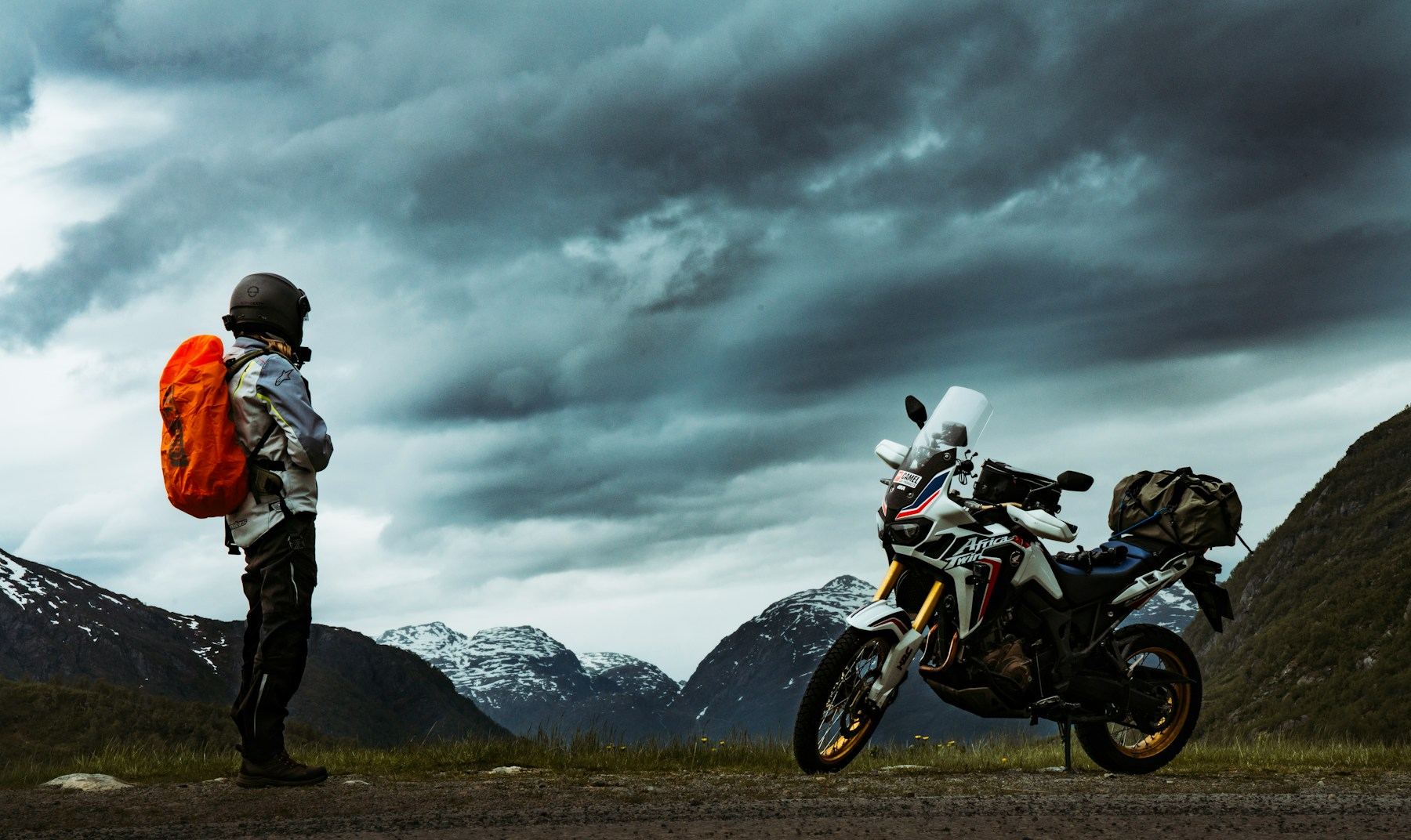
A useful motorcycle packing list is built around the route, motorcycle and rider—not a fixed number of bags. The essentials for a hotel-based weekend are different from those for remote camping, while documents and protective equipment change at borders.
Use this checklist as a decision tool. Confirm the motorcycle’s load limits, remove items that do not solve a realistic problem and test the final load before the trip.
Start with four trip questions
- Where will you sleep? Hotels remove the tent, sleep system and most cooking equipment.
- How remote is the route? Distance from fuel, repair and medical help determines tools, water and first-aid depth.
- What weather is plausible? Pack for the route’s elevation and forecast range, not only the departure town.
- What must cross a border? Verify identity, licence, registration, insurance, health and medication requirements for every country.
The motorcycle road-trip planning guide covers riding hours, fuel margins, alternatives and the loaded shakedown. Complete that outline before deciding how much equipment to carry.
Riding equipment
- Approved helmet in good condition, with a clean clear visor.
- Protective jacket and trousers suitable for the forecast range.
- Motorcycle gloves; add a dry or warmer pair where conditions justify it.
- Protective boots that remain comfortable for the full riding day.
- Hearing protection that fits correctly beneath the helmet.
- Waterproof outer layer if the main suit is not reliably waterproof.
- Warm layer and neck protection where temperature or elevation may change.
- Any legally required reflective or emergency equipment for the countries on the route.
Do not begin a long tour with an untested helmet, boots, gloves or earplugs. Pressure points that seem minor during a short ride become a distraction over several hours.
Clothing: pack a washable system
Build a small rotation around quick-drying layers and planned laundry. Trip duration does not need to equal the number of shirts or socks.
- Two or three base-layer tops appropriate to the climate.
- Two or three sets of underwear and riding socks.
- One insulating mid-layer.
- One compact set of off-bike clothing.
- Lightweight off-bike footwear where space allows.
- Sun, swim or cold-weather items only when the itinerary requires them.
- A separate bag for wet or dirty clothing.
Avoid a universal quantity rule. Riders who camp in cold weather need a different clothing system from riders using accommodation in summer.
Tools and motorcycle-specific spares
Carry only tools that fit the motorcycle and that you know how to use. Start with the factory toolkit, then test every planned roadside task at home.
- Tyre-pressure gauge and a suitable inflation method.
- Repair equipment matched to tubed or tubeless tyres.
- Correct tools for panels, battery access, chain adjustment and wheel removal where relevant.
- Motorcycle-specific fuses and other small spares justified by the model.
- Chain lubricant where required by the manufacturer.
- Compact tape, cable ties and a method of securing damaged luggage away from wheels and exhaust.
- Roadside-assistance details for failures that cannot be repaired safely.
A spare part is not useful if fitting it requires equipment or skill you do not have. Major maintenance belongs before the trip, with enough time for a test ride.
Documents and money
- Valid driving licence for the motorcycle category.
- Passport or accepted national identity card where required.
- Vehicle registration document.
- Proof of compulsory insurance and details of optional cover.
- Roadside assistance, medical/travel insurance and emergency contacts.
- Rental permission for every border if the motorcycle is hired.
- Payment cards with a separate backup and a modest amount of local cash.
- Required permits, vignettes, ferry confirmations or accommodation details.
EU-issued driving licences are generally recognised across the EU, but provisional documents are not automatically accepted abroad. EU compulsory third-party motor insurance is valid across the Union; optional damage, theft and rider cover depends on the contract. Registration papers should be carried when travelling with the vehicle.
Keep secure offline copies and policy numbers separately from the originals. A photograph is useful for recovery, but it does not automatically replace a document that must legally be carried.
Navigation and power
- Phone or navigator with offline maps downloaded.
- Weather-protected mount that does not obscure controls or instruments.
- Charging lead and tested motorcycle power outlet.
- Backup battery stored away from heat and water.
- Accommodation addresses, fuel stops and key route decisions available offline.
- A second navigation method: another device or a compact paper overview.
Do not place every document, route and payment method on one phone. A failed mount, empty battery or damaged screen should inconvenience the trip, not end it.
Health and first aid
The CDC recommends tailoring a travel health kit to the traveller’s health, itinerary, duration, access to medical care and the group’s actual skills. Keep it durable, water-resistant and accessible.
- Personal prescription medication in its original labelled container, plus required documentation.
- Basic wound-cleaning and dressing supplies that the rider knows how to use.
- Protective gloves and an emergency contact card.
- Sun protection, insect protection or water treatment where the route requires it.
- Medical and evacuation insurance details.
Check border restrictions for medication rather than assuming a prescription makes every medicine legal everywhere. Training in first aid is more useful than carrying advanced equipment without the knowledge to use it.
Camping additions
Add this module only for nights without accommodation:
- Shelter rated for expected wind and rain.
- Sleep system appropriate to the expected temperature.
- Cooking equipment and fuel that are legal and available on the route.
- Food storage appropriate to wildlife and local campsite rules.
- Water capacity and treatment method matched to reliable refill points.
- Small light and a way to keep essential equipment dry.
Do not attach loose items externally where they can enter the rear wheel, chain, belt or exhaust. Camping weight must remain inside the motorcycle and luggage manufacturers’ limits.
Load limits and placement
The motorcycle owner’s manual is the controlling source. Maximum permissible load includes the rider, passenger, luggage and accessories—not luggage alone. Panniers, racks and top boxes may also have their own weight and speed restrictions.
- Place dense items low and close to the motorcycle’s centre.
- Keep left and right loads reasonably balanced without chasing an arbitrary kilogram tolerance.
- Respect each case, rack and motorcycle limit.
- Do not block lights, registration plate, steering or suspension travel.
- Keep items clear of exhaust heat and moving parts.
- Set tyre pressure and suspension for the actual load using manufacturer guidance.
The Motorcycle Safety Foundation advises packing with weight in mind and making sure the rider can easily control the loaded motorcycle. Perform low-speed turns, stops, braking and a short rough-road test before departure. Recheck mounts and straps after the first riding stop.
Final departure checklist
- Remove every item with no realistic use case.
- Complete a T-CLOCS motorcycle inspection.
- Confirm tyre and suspension settings for the loaded condition.
- Test that the motorcycle can be mounted, parked and moved at walking pace.
- Put rain gear, water, documents and first aid within easy reach.
- Download maps and send the route to an emergency contact.
- Photograph the loaded motorcycle and luggage arrangement for reference.