From Alpine passes to lavender fields—your complete guide to riding la belle France
May–October
Best Season
Right Side
Driving Side
Nationwide
Regulated Filtering
Check Daily
High-Pass Status
Why France Is a Motorcyclist's Paradise
France has everything a motorcycle traveler could want: the highest Alps in Western Europe, the dramatic Pyrenees, Mediterranean coastline, Atlantic beaches, and endless kilometers of quiet D-roads through rolling countryside. It's vast, varied, and utterly rider-friendly.
The Route des Grandes Alpes threads roughly 720km from Lake Geneva to the Mediterranean, crossing more than a dozen passes. The Route Napoléon follows Bonaparte's escape route through Provence. The Verdon Gorge offers cliff roads that rival the Amalfi Coast. And everywhere, village cafés serve excellent espresso while you plan your next stretch of road.
France is practical for touring because its road network gives riders several choices between regions. Autoroutes save time but charge tolls; N and D roads are slower and often more useful for scenic itineraries. Road surface, fuel availability and traffic still vary by department and altitude.
Riding Rules & Regulations
Speed Limits
- Built-up areas: 50 km/h
- Open roads (single carriageway): 80 km/h by default since 2018—but since 2019 many départements have restored 90 km/h on parts of their network, so watch the posted signs
- Dual carriageways: 110 km/h (100 km/h in rain)
- Motorways (autoroutes): 130 km/h (110 km/h in rain)
⚠️ Fixed and mobile enforcement is common. Devices intended to detect or disrupt enforcement are prohibited. Use posted limits and official traffic information rather than relying on an alert-device workaround.
Headlights: Mandatory at all times, day and night.
Helmet: Required. Must display reflective stickers (usually pre-applied on EU helmets). Non-compliant helmets can result in fines.
High-visibility vest: A CE-marked vest must be on the rider or stored on the motorcycle. After an emergency stop, it must be worn before leaving the immobilised motorcycle on or beside the road.
Gloves: CE-marked motorcycle gloves are MANDATORY for riders and passengers. This is enforced.
Blood alcohol limit: 0.05% (0.02% for new drivers).
Lane filtering: Regulated filtering became legal nationwide on 9 January 2025, but only for motorcycles and three-wheelers under one metre wide, between the two leftmost lanes of divided roads with at least two lanes each way and a posted limit from 70 to 130 km/h. Traffic must be dense and continuous. Maximum filtering speed is 50 km/h, reduced to 30 km/h when one queue is stationary; it remains prohibited on other roads and in snow, ice or roadworks.
Crit'Air & low-emission zones (ZFE): Several French cities use low-emission zones where a Crit'Air vehicle sticker may be required and older motorcycles can be restricted. The category depends on registration date and emissions standard. If your route enters a large city, use the official certificat-air.gouv.fr service and check that city’s current rules before travel.
Winter equipment (Loi Montagne): From 1 November to 31 March, designated mountain areas require winter tyres or chains on many vehicles. This is off-season for most riders, and two-wheelers have historically been treated separately, but if you're in the mountains in that window verify the current obligation locally.
Mandatory Equipment
⚠️ Required by Law
- CE-marked gloves: Must be worn by both rider and passenger
- High-visibility vest: Must be on the rider or stored on the motorcycle, and worn after an emergency stop when leaving the bike on or beside the road
- Helmet with reflectors: Four reflective stickers required (usually factory-fitted on EU helmets)
- Warning triangle: Not required for motorcycles
- Working equipment: Required lights, brakes, tyres, plate and steering lock must be compliant and functional
Best Time to Ride France
June & September
Often the best balance of weather and traffic. High-pass openings remain snow-dependent, so June does not guarantee that every Alpine road is available.
July & August
Hot in the south (35°C+), crowded everywhere, French vacation period. Roads can be congested, especially coastal and Alpine routes.
April/May & October
Shoulder season. Some high passes closed. Spring flowers (May) or autumn colors (October). Variable weather but great for Provence and Pyrenees.
Regional Timing
- French Alps: Mid-June to mid-October. Col de la Bonette and Col de l'Iseran (highest paved roads) open late June
- Provence: March–November. June for lavender, autumn for lower crowds
- Pyrenees: May–October. Tourmalet and Aubisque usually open by early May
- Brittany/Normandy: April–October. Cooler and wetter than the south
- Corsica: May–October. July/August crowded; ferries book out
Fuel Stops & Services
French Fuel Network
- Prices: Pump prices change frequently. Compare the displayed price and refuel in valley towns before long pass sections
- Types: "Sans Plomb 95" (E10) is standard. "Sans Plomb 98" available at most stations. "SP95-E5" for older bikes
- Autoroute stations: Convenient but often more expensive than town or supermarket stations
- Payment: Most accept cards. Some rural automated pumps require chip-and-PIN (may reject foreign cards)
⛽ Mountain Fuel Planning
- • Route des Grandes Alpes: Fill in Thonon, Bourg-St-Maurice, Briançon, Barcelonnette
- • Verdon Gorge: No fuel in the gorge—fill in Castellane or Moustiers
- • Pyrenees: Fill in valley towns—passes rarely have stations
- • Corsica: Stations sparse inland—fuel in coastal towns
Toll Roads & How to Avoid Them
Many French autoroutes are privately operated and tolled. Motorcycles are normally billed as Class 5, with the actual amount depending on the operator and journey. Use the current operator calculator rather than an old end-to-end price quoted by a travel site.
If You Must Use Autoroutes
- Payment lanes: "Voie Automatique" (card), "Voie Monétique" (cash + card), "Télépéage" (electronic tag)
- Electronic tags: Télépéage tags speed you through the barriers. You don't need a French bank account—providers such as Bip&Go, Ulys and Emovis issue tags to foreign riders (some with a small subscription)
- Motorcycle tip: Use a lane displaying a motorcycle-compatible payment method, keep distance from the vehicle ahead and wait for the barrier to complete the previous transaction before advancing
✓ Free Alternatives
The Routes Nationales (N roads) and Routes Départementales (D roads) are free and far more scenic. GPS navigation set to "avoid tolls" usually finds great alternatives. The RN7 from Paris to Provence is a legendary toll-free road.
Must-Ride Routes in France
The official classic itinerary runs roughly 720 km from Thonon-les-Bains to Nice, with high roads including Iseran, Galibier and Izoard and several documented variants. Allow at least four days and verify each day's pass openings.
Following Bonaparte's 1815 escape route from Golfe-Juan to Grenoble. 325km of sweeping curves through Provence and into the Pre-Alps. Less technical than the Alpine passes but beautifully flowing. Perfect for sport-tourers.
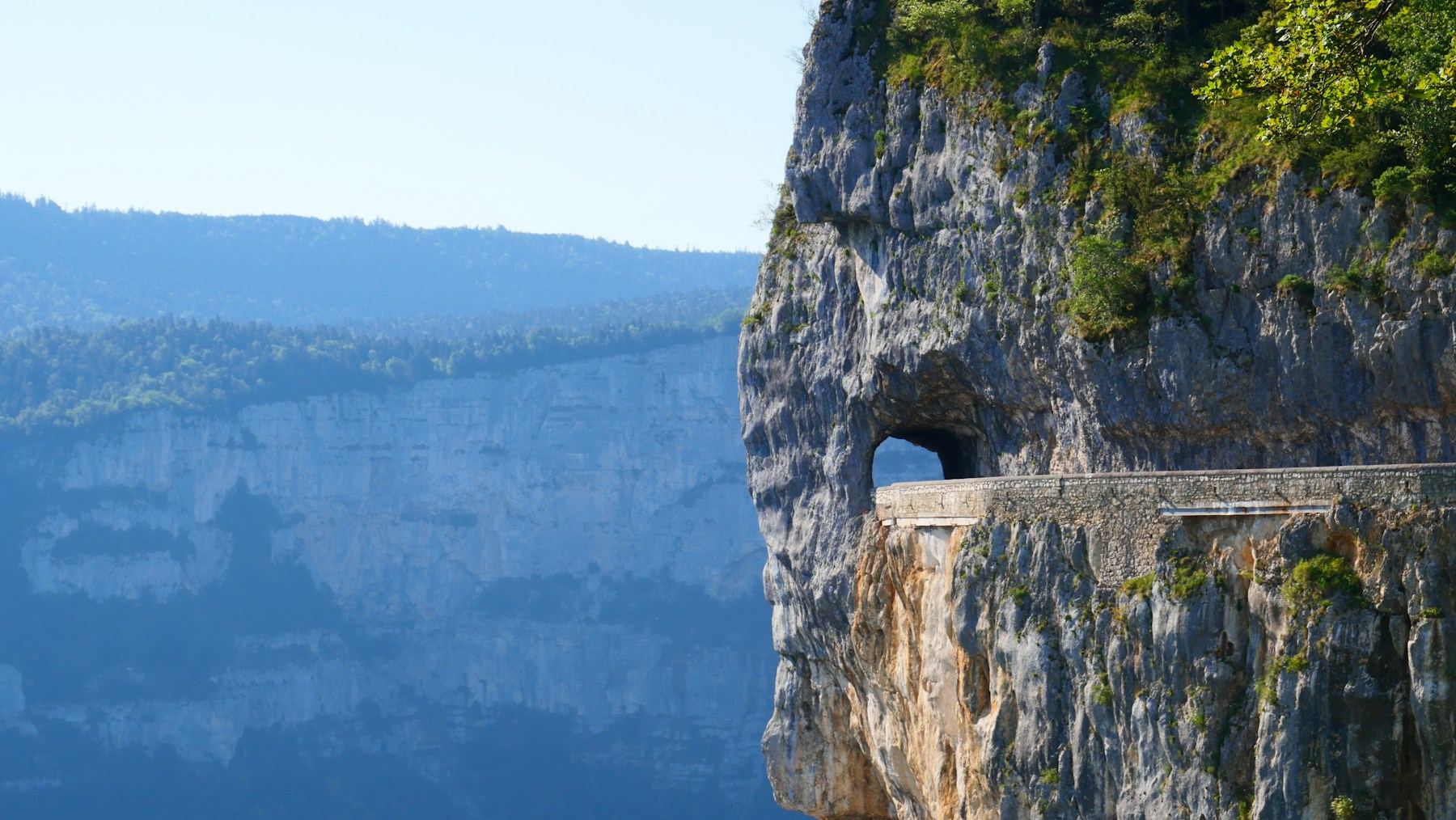
Europe's Grand Canyon with roads carved into cliffs up to around 700m high. The D71 and D952 loop the gorge with tunnels, hairpins, and vertigo-inducing views; the Route des Crêtes (D23) spur off the north rim is a highlight but is one-way in parts and closed over winter, so it's a warm-season ride only. The turquoise water below looks unreal. Go early morning to beat the tour buses.
One of the highest paved roads in the Alps—the loop around the Cime de la Bonette tops out at 2,802m (the col itself sits at 2,715m). Barren, lunar landscapes at the top. The south approach from Jausiers is technical and beautiful. The north from Saint-Étienne-de-Tinée is relentlessly twisty.
Pyrenees: Col du Tourmalet & Col d'Aubisque
Tour de France legends in motorcycle form. The Tourmalet (2,115m) is the most-crossed pass in Tour history. The Aubisque offers exposed cliff sections with views into Spain. Less crowded than the Alps and equally dramatic.
Food, Wine & the French Riding Lifestyle
The French Café Stop
Village cafés and bakeries make convenient rest stops, but opening hours and service vary outside tourist centres. In small settlements, identify an alternative stop rather than assuming food will be available throughout the afternoon.
- "Un café": Espresso. The default.
- "Un café allongé": Lengthened espresso—more like American coffee
- "Un café crème": Espresso with steamed milk
- "Un demi": A small beer (about 250ml)
Lunch hours: Many independent restaurants concentrate service around midday and reopen for dinner. Check opening times, especially in smaller villages and outside peak season.
Picnic option: French supermarkets and boulangeries make incredible picnic supplies. Grab bread, cheese, charcuterie, and find a scenic viewpoint—often better than any restaurant.
Wine regions: Burgundy, Provence, Alsace, and Bordeaux all offer fantastic riding through vineyards. Just remember the 0.05% limit—save the tasting for evening.
Where to Stay
Chambres d'hôtes: French B&Bs, often in farmhouses or village homes. Ask explicitly about covered or secure motorcycle parking before booking.
Logis de France: Network of independent hotels, many with restaurants. Look for "Logis" signs—consistent quality across the country.
Camping: France has a broad campsite network, including municipal sites. Opening dates and facilities vary, especially in mountain areas.
Informal camping: Do not assume a blanket right to camp. Restrictions depend on land status and local rules; use an authorised campsite or obtain the landowner’s permission when in doubt.
Gîtes: Self-catering cottages. Better for groups or longer stays.
Frequently Asked Questions
When does the Route des Grandes Alpes fully open?
There is no guaranteed full-opening date. The highest passes often open later than lower roads, and weather can cause temporary closures after snow clearing. Use the relevant departmental road-information service and keep a lower-altitude alternative for every high-pass day.
Are French drivers motorcycle-friendly?
Road behaviour varies more by location and congestion than by country stereotype. Do not assume a driver has seen you, even where regulated filtering is common.
Should I take the ferry to Corsica?
Absolutely worth it. Corsica has incredible mountain roads (D84 through the Calanches, Col de Bavella) and coastal routes. Ferries run from Nice, Marseille, and Toulon to Bastia, Ajaccio, and other ports. Book early in summer—they fill up.
What about the mandatory equipment rules?
Take them seriously. Rider and passenger need CE-certified gloves, an approved helmet and access to a CE high-visibility vest. The vest must be worn after an emergency stop if you leave the immobilised motorcycle on or beside the road.
How's the fuel availability in the mountains?
Limited at altitude but valley towns are well-supplied. The Route des Grandes Alpes has sufficient fuel stops if you plan ahead. Never pass a station with less than half a tank in mountain areas.
Is filtering legal in France?
Yes, under national rules introduced on 9 January 2025. It is limited to qualifying divided roads, between the two leftmost lanes, in dense continuous traffic, at no more than 50 km/h or 30 km/h when one queue is stationary. It remains illegal on ordinary urban streets and undivided roads.
Explore More
Final Thoughts
France rewards the rider who takes their time. Yes, you can blast down the autoroute from Calais to the Alps in seven hours. But you'd miss everything that makes French touring special: the D-roads through vineyards, the village boulangeries, the mountain refuges, the long lunches that turn into afternoon adventures.
A slower itinerary leaves room for changing weather, village stops and the official alternatives needed when a high pass is closed. That flexibility is more valuable than completing a saved route at any cost.