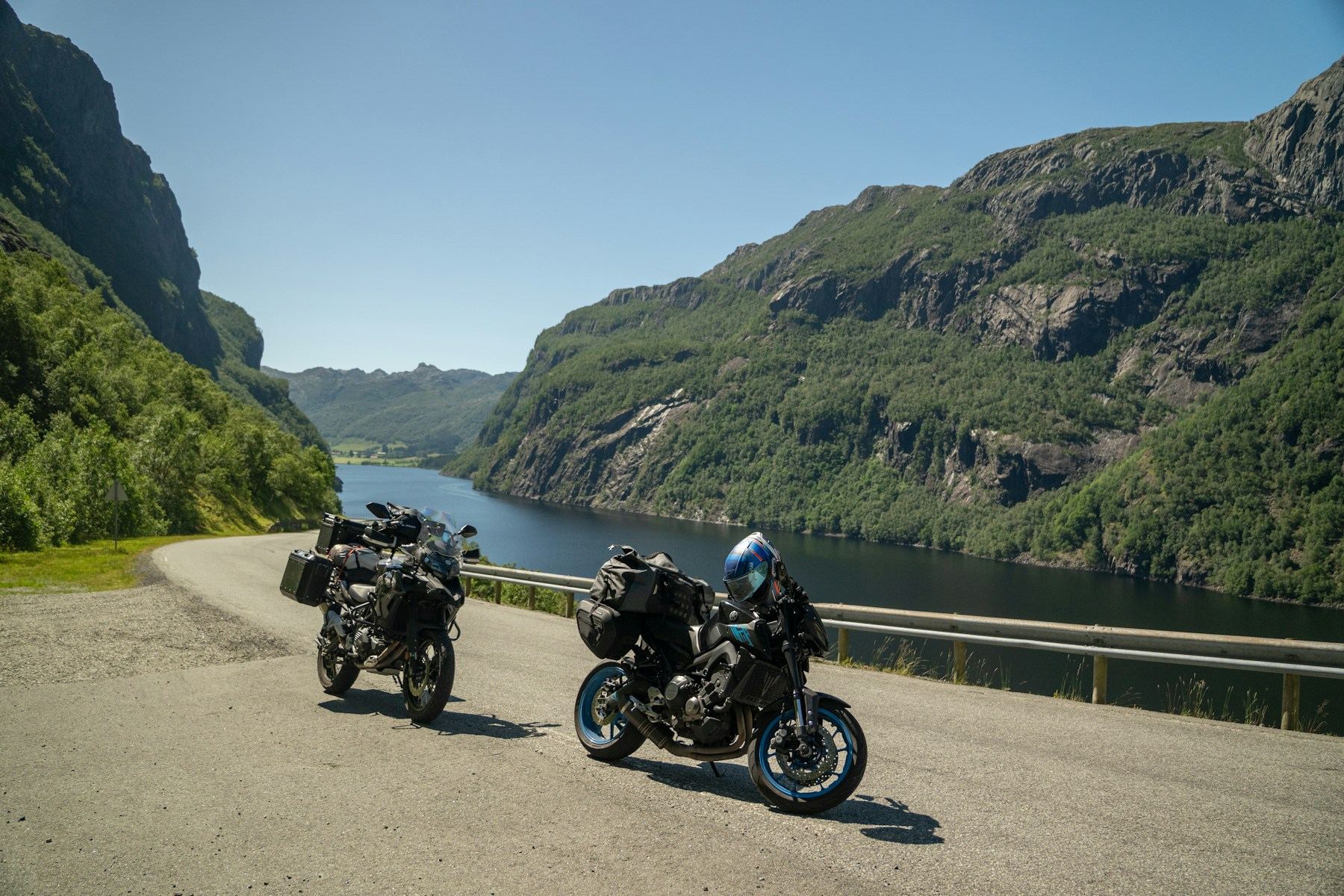
The ultimate guide to riding through fjords, mountain passes, and the land of the midnight sun
June–August
Best Season
Right Side
Driving Side
Toll-exempt
Automatic Road Tolls
18
National Scenic Routes
Why Norway Is a Motorcyclist's Paradise
Norway combines fjord roads, exposed coastal sections, mountain plateaus and long-distance Arctic riding in one country. The reward is not outright speed but a succession of viewpoints, ferries, tunnels and roads that descend from high ground to the water.
Summer daylight can be exceptionally long, with midnight sun north of the Arctic Circle around midsummer. Day length depends heavily on latitude and date, so check the conditions for the specific part of Norway you plan to ride.
Norway still requires preparation. Services are farther apart in remote districts, mountain weather can change quickly, and ferry timetables shape many itineraries. This guide separates stable rules from details that should be checked shortly before departure.
Riding Rules & Regulations
Speed Limits
- Built-up areas: 50 km/h (sometimes 30 km/h in residential zones)
- Rural roads: 80 km/h
- Main highways: 90-100 km/h
- Motorways: 110 km/h (rare in Norway)
⚠️ Penalties can be substantial and the posted limit always controls. Allow extra time instead of building an itinerary around maximum legal speeds.
Headlights: Mandatory at all times, day and night. Most modern bikes do this automatically, but check yours before crossing the border.
Helmet: Required for all riders and passengers. Must meet ECE 22.05 or 22.06 standards.
License: EU/EEA licences are generally valid. Riders using a licence from elsewhere should check the current recognition and translation rules with the Norwegian Public Roads Administration before travel.
Reflective gear: Statens vegvesen recommends using reflective material to improve visibility. Its motorcycle-equipment guidance does not state a blanket requirement for visiting riders to carry a reflective vest.
Blood alcohol limit: 0.02%—essentially zero tolerance. Even a single beer can put you over.
Filtering: Do not treat filtering as a separate entitlement. Ordinary lane, overtaking, no-passing and shoulder rules still apply; ride predictably and never use the hard shoulder as a traffic lane.
Best Time to Ride Norway
Peak Season: Mid-June to Mid-August
- ✓ Best chance of seasonal mountain roads being open
- ✓ Midnight sun north of Arctic Circle
- ✓ Warmest temperatures (15-22°C)
- ✓ Most ferry routes run their fullest schedules
- ✗ Highest tourist crowds
- ✗ Most expensive accommodation
Shoulder Season: Late May & September
- ✓ Fewer tourists, cheaper lodging
- ✓ Still long daylight hours
- ✓ Most passes accessible
- ✗ Some high passes may have snow
- ✗ Unpredictable weather
- ✗ Reduced ferry schedules
Planning recommendation: Late June offers long daylight and usually better access to seasonal roads, while early September can be quieter but carries a greater risk of cold weather and early closures. Check every key mountain road in the official traffic service before committing to the day’s route.
Fuel Stops & Services
Fuel Strategy in Norway
Fuel prices change frequently, so use current local prices when budgeting. The more important issue is range: identify fuel stops in advance on remote legs and refill with a comfortable reserve rather than relying on the next small settlement.
- Major chains: Circle K, Shell, Esso and YX are widely represented, but card acceptance should be confirmed for your own issuer
- Automated stations: Common outside larger towns; carry a second payment card in case one issuer is declined
- Opening hours: Staffed stations often close by 20:00. Automated pumps work 24/7
- Tip: Mark several alternative fuel stops in an offline map before entering sparsely populated areas
⛽ Critical Fuel Gaps
- • Trollstigen area: Fill up in Åndalsnes or Valldal—no stations on the pass
- • Lofoten Islands: Fuel in Svolvær or Leknes—limited options between
- • Nordkapp route: Fill in Alta or Honningsvåg—200+ km gaps possible
- • Hardangervidda: Fuel before crossing—no stations on the plateau
Tolls, Tunnels & Ferries
Toll System (AutoPASS)
Norway uses automatic toll collection on many roads. Under the current official AutoPASS exemption rules, motorcycles and mopeds are not charged at automatic road toll stations.
- Automatic road tolls: No agreement or tag is needed merely to receive the motorcycle exemption
- Correct registration class: Make sure the vehicle is registered as a motorcycle; contact AutoPASS if a charge is issued incorrectly
- Ferries: Ferry payment is a separate system and should not be confused with the automatic-road-toll exemption
Ferry Crossings
Ferries are part of the road network, but fares and payment arrangements vary by route. Some connections are free while others charge motorcycles, so check the operator or AutoPASS for ferry before travel.
- Booking: Local crossings often work as turn-up services, but longer or capacity-constrained routes may accept or require reservations
- Payment: Motorcycles can use an AutoPASS for ferry prepayment agreement without a tag; the plate is photographed. FerryPay or route-specific card payment may also be available
- At the terminal: Follow staff instructions rather than assuming priority placement or a fixed boarding order
- Scenic ferries: Geirangerfjord and Hjørundfjord crossings are attractions in themselves
Road Conditions & Hazards
Norwegian roads range from silky-smooth coastal highways to potholed mountain tracks. The main tourist routes (National Scenic Routes) are excellently maintained. Smaller roads can be rough, especially after winter.
What to Expect
- Tunnels: Norway has 1,100+ tunnels—some 25km long. Expect wet surfaces, poor lighting, and sudden temperature drops
- Single-lane roads: Common in rural areas. Use passing places and give way to uphill traffic
- Gravel sections: Some mountain roads have unpaved stretches—check conditions before remote routes
- Livestock: Sheep and reindeer roam freely in summer—especially in the north
Weather Hazards
- Fog: Coastal areas get sudden fog banks—carry clear visor
- Wind: Exposed mountain passes and coastal roads can have dangerous gusts
- Rain: Common even in summer—waterproof gear is essential, not optional
- Snow: Possible on high passes even in July—check vegvesen.no for road status
Accommodation Options
Accommodation costs vary sharply by date and region. Compare current rates early for summer travel, and keep campsites or cabins as alternatives on flexible itineraries.
Wild camping: The right to roam normally allows tent camping on uncultivated land at least 150 metres from an inhabited house or cabin. The usual limit is two nights in one place outside remote mountain areas, and local rules or fire restrictions can be stricter.
Campsites: Facilities and prices vary; many offer showers, cooking areas and cabins ("hytter"). Check whether bedding and cleaning are included.
DNT huts: Norwegian Trekking Association cabins scattered throughout wilderness—basic but atmospheric. Book via ut.no.
Hostels: Available in several larger towns and useful when weather makes camping unattractive.
Hotels: Book early in peak season. Check thon.no and nordicchoice.com for motorcycle-friendly chains with secure parking.
💡 Money-saving tip
Many ferries to remote areas (like Lofoten) have overnight cabins. Book a cabin on an evening ferry—you save a night's accommodation AND arrive at dawn for empty roads.
Must-Ride Routes in Norway
Eleven hairpins climb the mountainside between Åndalsnes and Valldal, while Ørnevegen adds another dramatic approach to Geiranger. Rockfall risk caused a long closure in 2024 and a delayed reopening in 2025. Conditions remain dynamic, so confirm the road status in Statens vegvesen’s live traffic service before planning the day around Trollstigen.
Eight bridges connect a chain of islands across a short, exposed coastal section. Wind and sea spray can make the road more demanding, so use the official forecast and postpone the ride when conditions exceed your experience or the motorcycle’s safe limits.
Jagged peaks, fishing villages and exposed coastal roads make Lofoten worth several days rather than a rushed transit. The E10 between Svolvær and Å is the main spine, with side roads providing slower detours and viewpoints.
27 hairpins descending 900m to a tiny fjord village. This is Norway's answer to Stelvio—technical, beautiful, and far less crowded. The road includes a tunnel with a 180° turn inside the mountain.
Practical Planning Tips
Carry cash: Card acceptance is nearly universal, but remote mountain cafés occasionally only take Norwegian kroner.
Download offline maps: Mobile coverage is patchy in the mountains. Google Maps, OSMAnd, or Organic Maps all work well offline.
Book ferries for Lofoten: The Bodø-Moskenes ferry fills up in summer—book at torghatten-nord.no.
Check pass status: Mountain roads close for weather. Always check vegvesen.no before heading to high passes.
Expect delays: Road construction is constant in summer. Pilot cars (following a lead vehicle through construction zones) are common—factor extra time.
Midnight sun mindset: North of the Arctic Circle, the sun doesn't set in June/July. Great for riding, terrible for sleep. Bring an eye mask.
Frequently Asked Questions
How expensive is a motorcycle trip in Norway?
There is no reliable fixed daily figure: accommodation, ferry choices, restaurant use and the distance covered create large differences. Build a current budget from your actual overnight stops, ferry fares and expected fuel consumption, then add a weather contingency.
Do I need a big adventure bike?
Not at all. Main roads are excellent for any bike. A mid-size naked or sport-tourer handles Norway beautifully. Only if you're planning serious off-road work (like the mountain tracks of Jotunheimen) do you need a true ADV bike.
When do the mountain passes open?
Opening dates vary by road, snow clearing and weather. Trollstigen had a long rockfall-related closure in 2024 and reopened later than normal in 2025; that history is a reminder not to rely on calendar assumptions. Check each seasonal road at vegvesen.no/en/traffic shortly before departure and again on the riding day.
Is it safe to ride in Norway?
Very safe. Roads are well-maintained, drivers are respectful, and emergency services are excellent. Main risks are weather changes, wildlife on roads, and tunnel-related fatigue. Keep headlight on, stay visible, and take breaks.
Can I wild camp anywhere?
Not literally anywhere. On uncultivated land, keep at least 150 metres from an inhabited house or cabin and normally move after two nights unless you are in a remote mountain area. Respect local bylaws, cultivated land, fire restrictions and leave-no-trace duties.
What about Northern Norway and Nordkapp?
The ride from southern Norway is a major long-distance undertaking. Expect longer gaps between services and cold or windy weather even in summer. Access arrangements and visitor-centre prices at the North Cape can change, so check the official Nordkapp site instead of treating an old quoted price as current.
Official sources used for this guide
- Statens vegvesen: Motorcycling in Norway
- Statens vegvesen: Motorcycle equipment
- AutoPASS: Toll exemptions
- AutoPASS for ferry: Motorcycle payment FAQ
- Norwegian Environment Agency: Camping and the right to roam
- Statens vegvesen: Live traffic information
Rules, closures and fares can change. Recheck the official services shortly before your trip.
Explore More
Final Thoughts
Norway can be expensive, remote and occasionally challenging, but its combination of fjords, coast, plateaus and Arctic daylight makes it a distinctive European motorcycle destination.
Plan conservatively, treat ferries as part of the itinerary and keep alternative routes for weather or closures. The strongest trips leave enough time to stop at viewpoints and adapt rather than chasing a rigid daily distance.